Uganda Safaris

Our Uganda safari packages are private trips built around your dates, your pace and your party — never a fixed departure with strangers. Uganda is the one country where you can trek mountain gorillas in the morning, track chimpanzees two days later, and still see elephant, lion and hippo from a boat on the Nile. You book and pay a US company in Utah; a licensed Kampala operator running since 2017 handles the ground.

Top Safari Destinations in Uganda

Bwindi Impenetrable National Park

Bwindi holds more than half of the world’s remaining mountain gorillas. It is the reason most Americans come to Uganda, and it deserves the reputation. The forest is genuinely thick, genuinely steep, and genuinely worth it.

Bwindi is not one place. It has four trekking sectors — Buhoma, Ruhija, Rushaga and Nkuringo — and your permit is tied to one of them. Which sector you get changes your drive, your lodge, and how hard the walking is. We pick the sector around you rather than around whatever was left.

Queen Elizabeth National Park

Uganda’s most-visited savanna park, sitting between the Rwenzori foothills and Lake Edward. The boat cruise on the Kazinga Channel puts you level with hippo, buffalo and elephant coming down to drink, and it is one of the easiest wildlife hours in East Africa — no walking, no heat, no bouncing.

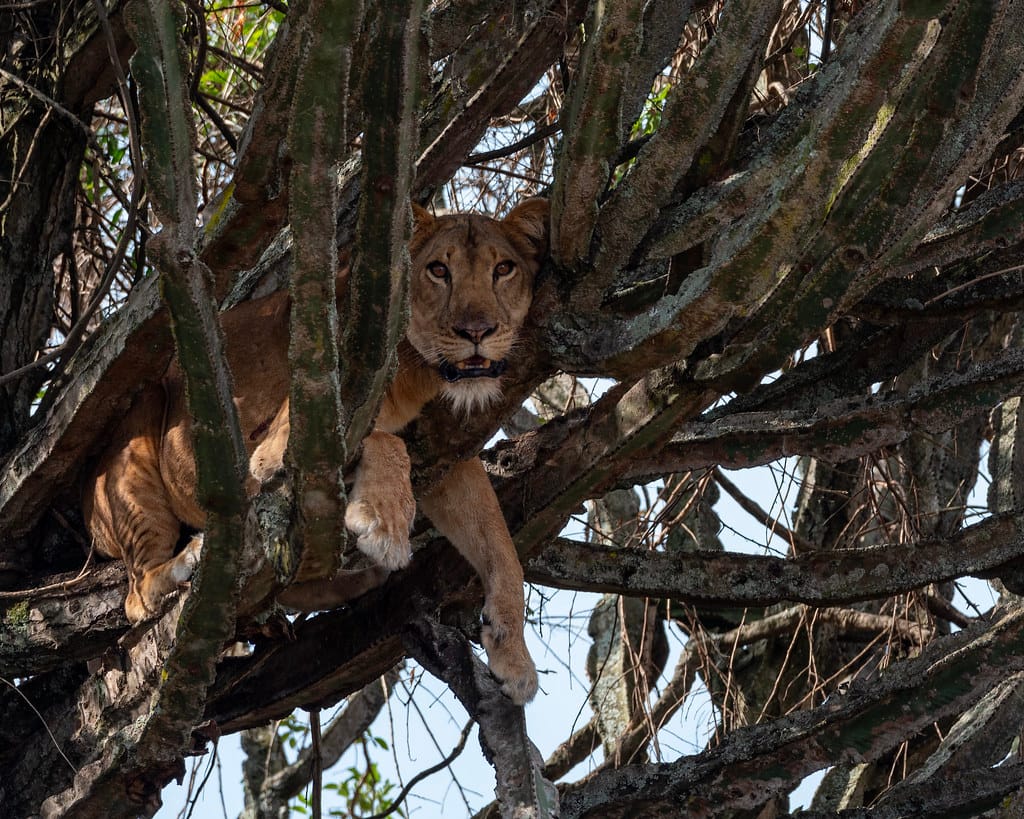
The southern Ishasha sector is where the tree-climbing lions are. They are not guaranteed. Nothing wild is. But Ishasha is also the natural overnight stop between Queen Elizabeth and Bwindi, so it rarely costs you a day to try.

Murchison Falls National Park

The largest park in Uganda, and Nicholas’s own favorite. The Nile is forced through a gap about twenty feet wide and drops through it with a noise you feel before you see. The boat trip to the base of the falls is the classic way to do it.

Above the falls the park opens into savanna with elephant, giraffe, lion and Uganda kob. It is the north-circuit anchor, and it pairs well with Ziwa on the drive up from Entebbe.

Kibale National Park

The best chimpanzee tracking in East Africa, with roughly 1,500 chimps and a habituated community that makes sightings reliable rather than lucky. Kibale is forest walking rather than climbing, and considerably gentler than a gorilla trek.

The neighboring Bigodi wetland is worth the extra half day if you like birds or want a slower morning.

Kidepo Valley National Park

Remote, empty, and the closest thing Uganda has to a classic Kenyan savanna. Kidepo sits in the far northeast against the South Sudan border, ringed by mountains, and receives a fraction of the visitors the southern parks do.

Getting there is the catch. It is a long drive or a short flight, and we will usually recommend the flight. If you want a park where you can go most of a morning without seeing another vehicle, this is the one.

Lake Mburo National Park

Small, close to the Kampala–Bwindi road, and the only Ugandan park with zebra. It is also one of the few where you can do a guided walking safari and a night drive, which are not permitted in most of the country.

Lake Mburo is the sensible first or last night of a southern circuit — it breaks up the long drive to gorilla country instead of adding to it.

Mgahinga Gorilla National Park

Uganda’s smallest park, in the Virunga volcanoes on the Rwanda border. It has one habituated gorilla family and, more distinctively, golden monkey tracking — a bright, fast, endemic monkey you will not see anywhere else in the region.

Permits here are less contested than Bwindi’s, which occasionally makes Mgahinga the answer when dates are tight.

Ziwa Rhino Sanctuary

The only place in Uganda with wild rhino, and you track them on foot with a ranger rather than from a vehicle. It sits directly on the road between Entebbe and Murchison Falls, so it costs you almost nothing in time.

Ziwa is also what completes the Big Five in Uganda. Without it, you are seeing four.

What you can actually do on a Uganda safari

Gorilla trekking

You walk into the forest with a ranger team, they find the family, and you get one hour. The walk can be forty minutes or it can be five hours — the gorillas move, and nobody can promise you a short day.

The hour itself is the part people underestimate. You are close. Close enough that the standard ten-yard rule is often decided by the gorillas rather than by you.

Chimpanzee tracking

Kibale is the place for this. Chimps are loud, fast and constantly moving, which makes for a completely different hour than the gorillas — less awe, more comedy. It is also easier walking, which matters if you are pacing a longer trip.

Game drives and boat safaris

Uganda’s savanna parks — Queen Elizabeth, Murchison Falls, Kidepo, Lake Mburo — run standard morning and afternoon game drives. What Uganda adds that most safari countries cannot is water. The Kazinga Channel and the Nile below Murchison Falls both put you on a boat, at eye level, with no dust.

Golden monkey tracking

Mgahinga only. A shorter, cheaper and much livelier trek than the gorillas, and a good add-on if you are already in the far southwest.

Hiking and nature walks

From short forest walks at Bigodi and Lake Mburo up to multi-day treks in the Rwenzori Mountains. Most clients want the short end of this. It is worth saying that walking anywhere in a Ugandan park is done with an armed ranger, which is normal practice and not a sign that something is wrong.

Cultural visits

Village and community visits around Bwindi and Lake Bunyonyi, the Batwa cultural experience at Mgahinga, and Kampala city tours. We book these through community-run programs rather than staged performances, and we will tell you plainly which is which.

Birding

Over 1,000 recorded species in a country the size of Oregon. If you are a birder you already know this. If you are not, the shoebill at Mabamba Swamp is the one that converts people.

What a Uganda safari costs

We quote every trip individually, because the honest answer depends on when you travel, what standard of lodge you want, and how many of you there are. What we can give you is the shape of it.

Our Uganda safari packages are all-inclusive: lodging, all meals, a private 4x4 with your own driver-guide, park entrance fees, gorilla and chimpanzee permits, and airport transfers. Prices are per person. Outside the quote sit international flights, your visa, travel insurance, tips, and any optional add-ons.

Three things move the number more than anything else. Permits are a fixed, non-negotiable block of the cost — see below. Lodge standard swings the total widely, and Uganda has real range here, from simple bandas to lodges on the Bwindi forest edge. And party size matters, because the vehicle and the guide are shared across your group rather than sold by the seat, so two people pay more each than four do.

Full detail on inclusions and exclusions is on our safari pricing page.

Gorilla permits: what they cost and how they work

This is the part that surprises people, so here it is straight.

A standard Uganda gorilla trekking permit is $800 per person for foreign non-residents. That buys you one hour with one family, on one specific day, in one specific sector. It is not a park fee you can spread across a week.

Uganda introduced a low-season permit at $600 for treks in April, May and November. That is a real $200 saving per person and almost nobody advertises it. The trade-off is rain and the fact that discounted permits cannot be rescheduled once booked.

The four-hour gorilla habituation experience in Bwindi’s Rushaga sector is currently $1,500 and rises to $1,800 on January 1, 2027. If that is what you want, booking in 2026 for a 2027 trek is worth real money.

For comparison, the same one-hour trek in Rwanda costs $1,500 per permit. Uganda is the value option in mountain gorilla tourism by a wide margin, and it is also where more than half the world’s mountain gorillas actually live.

Two rules worth knowing before you plan. First, the Uganda Wildlife Authority requires foreign non-residents to book permits through a licensed Ugandan operator — you cannot buy one yourself. Second, permits must be paid in full at the time of booking; the old practice of holding a permit unpaid is gone. Peak-season dates in the popular sectors routinely sell out six to ten months ahead.

That first rule is worth sitting with, because it is exactly the situation American travelers get nervous about — you are required to send money to a company you found on the internet in order to hold the single most expensive line item of your trip.

How the money actually works

You pay All in Africa Safaris USA, a company registered here in Utah, under a US contract. Nobody asks you to wire funds to an individual, send cryptocurrency, or pay a WhatsApp contact.

The ground operation is All in Africa Safaris (U) Ltd, Nicholas Bright’s licensed company in Kampala, running since 2017. They hold the UWA operator license that makes your permit purchase legal, and they supply the guides, vehicles and reservations. We handle you; they handle the ground.

You also get a phone number in Mountain Time that a person answers. If something needs sorting the week before you fly, you are not composing an email at 2 a.m. and hoping.

Your vehicle and your guide

Every Uganda trip we run is private. A 4x4 with a pop-up roof, your own driver-guide, and a schedule that is yours to change on the morning of.

This is the whole difference. A seat in a shared minibus means a fixed departure time, a fixed route, and other people who want to move on while you are still watching. The animals are the same either way. The day is not. Your journey is private; the wildlife encounter is shared.

Uganda involves real driving — Entebbe to Bwindi is most of a day. If you would rather not spend it in a vehicle, there are scheduled and charter flights to airstrips near most of the parks. Barton asked for exactly that on his own first trip, and it is now something we build in routinely. See airports and fly-in options.

Common questions about a Uganda safari

How many days do I need?

Three days is enough to fly in, trek gorillas and fly out, and people do it. Six to seven is where Uganda starts making sense — gorillas plus chimps plus one savanna park. Ten opens up Murchison or Kidepo without long driving days stacked back to back.

Am I fit enough to trek gorillas?

Probably, and more people manage it than expect to. It is steep, muddy, humid forest walking at altitude, without technical difficulty. The honest test is whether you can walk uphill for two to three hours with breaks.

Two things help more than training. Rangers assign trekking groups partly by fitness, so tell them the truth rather than what you wish were true. And porters cost around $20, carry your pack, and will physically haul you up a slope — hire one even if you think you will not need one. The minimum age is 15, and there is no upper limit.

Uganda or Rwanda for gorillas?

Rwanda is easier and faster — Kigali to the park is under three hours on good roads — and costs $1,500 per permit. Uganda costs $800, involves more driving, and has far more to do once you are there. If gorillas are the only thing you want and time is short, Rwanda. If you want a safari that happens to include gorillas, Uganda.

Is Uganda safe for American travelers?

The tourism circuit is stable and you are with a professional guide the entire time. The realistic risks are sunburn, dehydration, stomach upset and mosquito bites rather than anything dramatic. Uganda is a yellow fever country, so that vaccination is required for entry and malaria prophylaxis is strongly recommended — check current guidance with the CDC and your own doctor. We require every client to carry travel insurance covering medical evacuation.

When should I go?

June to September and December to February are the dry seasons, with firmer trekking ground and higher prices. April, May and November are the wet months — greener, quieter, cheaper, and the only months the $600 gorilla permit applies. Uganda sits on the equator, so it never gets hot the way people expect; mornings at altitude in Bwindi are genuinely cold.

How far ahead should I book?

For peak-season gorilla trekking, six to ten months. Permits are capped at eight people per gorilla family per day and there is no way around that ceiling. If your dates are fixed — an anniversary, a retirement — book the permit first and build the trip around it.

Our Popular Uganda Tours

All in Africa Safaris arranges tours to Uganda, Rwanda, Kenya and Tanzania
Silverback mountain gorilla, Bwindi Impenetrable National Park, Uganda

3-Day Private Gorilla Trekking Safari

The simplest way to see mountain gorillas in Uganda — one trek in Bwindi Impenetrable National Park.
Chimpanzee on the forest trail, Kibale National Park, Uganda

7-Day Uganda Gorilla & Chimpanzee Safari

Kibale's chimpanzees, Queen Elizabeth's wildlife, and Bwindi's gorillas in one private trip.
Crocodile and stork on the Kazinga Channel, Queen Elizabeth National Park, Uganda

10-Day Private Uganda Safari

Gorillas, chimps, rhinos, and Big Five wildlife across five parks — Uganda's full spectrum.
All in Africa Safaris USA Logo
A Utah company and a Ugandan team. We build private, custom safaris across Uganda, Rwanda, Kenya, and Tanzania — gorilla trekking, the Great Migration, and everything in between. No group departures, no shared vehicles, and one person who plans your trip from the first email to the day you land back home.
© 2026 All in Africa Safaris USA LLC. All rights reserved