Our Tanzania safari packages are private trips built around your dates, your pace and your party — never a fixed departure shared with strangers. Tanzania holds the Serengeti, the Ngorongoro Crater, Kilimanjaro and Zanzibar, which is an unreasonable amount for one country. You book and pay a US company registered in Utah; a licensed East African operator running since 2017 handles the guides, vehicles and reservations on the ground.
Roughly the size of Connecticut, and the stage for the Great Migration — around two million wildebeest and zebra moving in a slow annual loop between the Serengeti and Kenya’s Masai Mara.
The migration is a year-round event in different places, which is the thing most first-time visitors get wrong. Calving season in the southern Ndutu plains runs late January into February and is, for many people, better than the river crossings: thousands of births in a few weeks, and the predator activity that follows. The Grumeti and Mara river crossings are roughly June through September in the north.
Where you stay in the Serengeti therefore depends entirely on when you go. Booking a central Serengeti camp in February puts you in the wrong place by several hours of driving.
A collapsed volcanic caldera about twelve miles across with roughly 25,000 large animals living inside it year-round. It is the most reliable Big Five sighting in Africa, including black rhino, which are genuinely hard to find anywhere else.
It is also busy and strictly managed. Vehicles get a six-hour limit on the crater floor, enforced at the gate. Going down early is the difference between a great morning and a queue.
Enormous baobabs and the highest elephant density in northern Tanzania, particularly from June to October when the animals concentrate along the Tarangire River. It is usually the first stop on a northern circuit and it is consistently underrated by people rushing to the Serengeti.
Small, green and easy, sitting under the Rift Valley escarpment. Famous for tree-climbing lions, though as with Ishasha in Uganda, they are a bonus and not a booking. Strong birdlife, flamingos on the lake in the right season, and a good half-day on the way north.
The highest mountain in Africa at 19,341 feet, and a walk rather than a climb — no technical skill required on the standard routes. It takes five to nine days depending on route, and the longer routes have substantially better summit success because they let you acclimatize.
Kilimanjaro is a separate trip from a safari, not an add-on day. Plan it as such.
An island off the Tanzanian coast with genuinely excellent beaches, and the natural way to end a safari. Stone Town is a UNESCO World Heritage site worth a day or two on its own for the architecture, the spice history and the food.
The flight from the Serengeti or Arusha is short, which is why Zanzibar works as an extension where a beach in most safari countries would not.
Ruaha and Nyerere (formerly Selous) are vast, wild and lightly visited. Nyerere offers boat safaris on the Rufiji River, which almost no northern-circuit park can match. Choose these if you have been on safari before and want fewer vehicles more than you want guaranteed density.
The core of it. Morning and afternoon drives in a private 4x4 with a pop-up roof, on your schedule rather than a shared departure’s.
Dawn launch, an hour drifting over the plains, champagne breakfast on landing. It runs around $600 per person on top of your itinerary and it is the most-requested add-on in Tanzania. Worth it if the Serengeti is the centerpiece of your trip.
Permitted in some parks and not others — Tarangire, Lake Manyara, Ruaha and Nyerere allow night drives; the Serengeti and Ngorongoro Crater do not. If walking or night driving matters to you, it shapes which parks we route you through.
Maasai community visits in the Ngorongoro area, and the Hadzabe and Datoga communities near Lake Eyasi. We book community-run programs rather than staged performances, and we will tell you plainly which is which.
Reef diving and snorkeling off the east and north coasts, dhow trips, and Stone Town. A three-to-four-night extension is the usual shape.
We quote every trip individually because the number depends on your dates, your lodges and how many of you there are. Two things about Tanzania are worth understanding before you compare any quotes.
First, Tanzania has the highest park fees in East Africa, and they are a large fixed block of your cost. Serengeti and Ngorongoro conservation fees run roughly $70 to $83 per person per day for foreign non-residents, and descending into the Ngorongoro Crater carries an additional service fee of about $295 per vehicle, per descent. Park entry is valid for 24 hours and is non-refundable once used.
Second, published fee figures disagree with each other all over the internet, and the reason is 18% VAT. Some sources quote fees with it and some without, which is a difference of roughly $12 per person per day. Tanzanian government fees are also reviewed each July. When you compare two operator quotes, the real question is whether park fees are inside the price or waiting for you at the gate. In ours they are inside.
Our Tanzania safari packages include lodging, all meals, a private 4x4 with your own driver-guide, all park and conservation fees, crater service fees where applicable, and airport transfers. International flights, visas, travel insurance, tips and optional extras like the balloon sit outside. Prices are per person, and party size moves them — the vehicle and guide are shared across your group rather than sold by the seat.
Full detail is on our safari pricing page.
You pay All in Africa Safaris USA, a company registered here in Utah, under a US contract. Nobody asks you to wire funds to an individual overseas, send cryptocurrency, or pay through a messaging app.
The ground operation is All in Africa Safaris (U) Ltd, Nicholas Bright’s licensed company in Kampala, working across Tanzania, Kenya, Rwanda and Uganda since 2017. They hold the operator relationships, the vehicles and the guides. We handle you from the US side; they execute in-country.
You also get a phone number in Mountain Time with a person answering it, which counts for more than most people expect the week before an international trip.
Every Tanzania trip we run is private. Your own 4x4 with a pop-up roof, your own driver-guide, and a schedule you can change that morning.
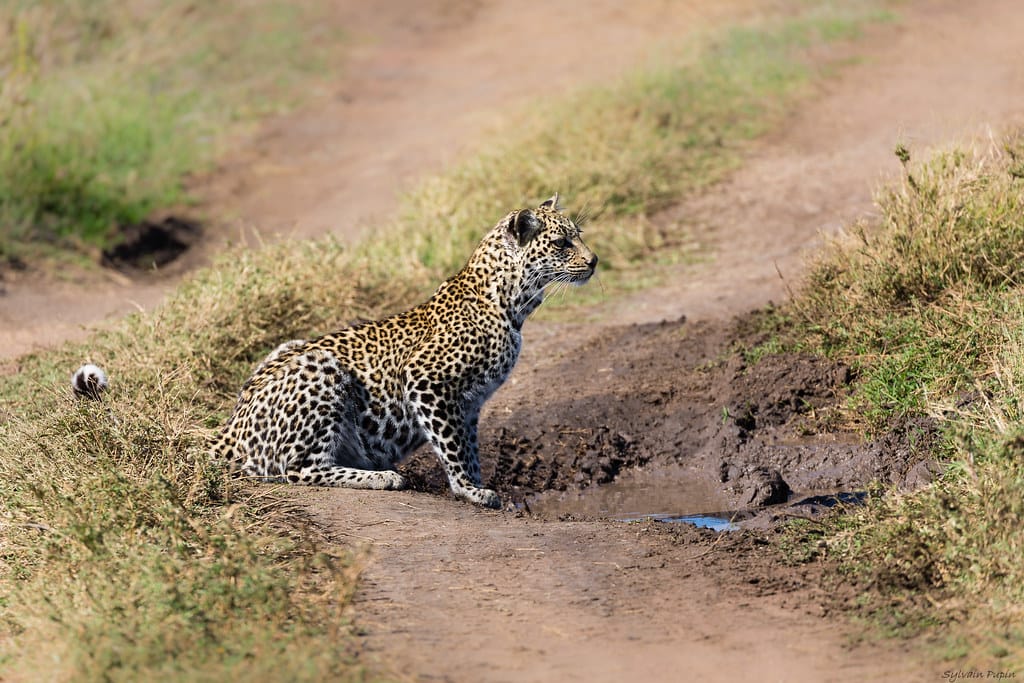
This is the actual product. A seat on a shared departure means a fixed route, a fixed departure time, and six other people ready to move on while you are still watching a leopard come down a tree. The wildlife is identical. The day is not. Your journey is private; the wildlife encounter is shared.
Tanzania’s distances are long, and light aircraft between the Serengeti, Arusha and Zanzibar are common and reasonably priced. If you would rather fly than drive, say so early — it changes the routing. See airports and fly-in options.
Six to seven days covers the northern circuit properly — Tarangire, Ngorongoro and three nights in the Serengeti. Under five and you spend a disproportionate share of it driving. Ten lets you add Zanzibar without compressing the safari.
June to October is the classic dry season: excellent game viewing, river crossings in the northern Serengeti, and peak prices. Late January to February is calving season in the south and, in our view, the better wildlife spectacle for a first trip. April and May are the long rains — lowest prices, greenest landscapes, some camps closed.
Both hold the same migration at different points in the year. Tanzania is bigger, wilder and more expensive, with higher park fees. Kenya is cheaper, more compact, and easier to combine with other things. If the Ngorongoro Crater or Kilimanjaro is on your list, that settles it — those are Tanzania only.
The safari circuit is well established and you are with a professional guide throughout. Realistic risks are sun, dehydration, stomach upset and mosquitoes rather than anything dramatic. Yellow fever vaccination is required if you arrive from a country with risk of transmission, and malaria prophylaxis is recommended — check current guidance with the CDC and your doctor. We require every client to carry travel insurance covering medical evacuation.
Six to twelve months for June–October or the February calving season. The good camps in the right part of the Serengeti are a genuinely limited resource, and being in the wrong camp at the wrong time of year is the most common and least fixable mistake in Tanzania planning.