

Utah Office | USA/Canada
Call or Text | +1 (801) 899-6806
Email Support safari@allinafricasafarisusa.com
Office Hours: M-F 9:00 am - 5:00 pm MST
Off: US Holidays
Off: US Holidays
Serengeti National Park is the reason most Americans picture Africa the way they do. Endless grass, a lion on a rock, a horizon with nothing built on it. What surprises most first-time visitors is that the reality is bigger and quieter than the documentary version — and considerably more comfortable than they expected.
This guide covers what the Serengeti actually is, when to go, what you will see, what it costs, and what a week there feels like day to day. It is written for a US traveler who has never been to Africa and wants to understand what they would be buying before they spend real money on it.
The park sits in northern Tanzania, running up to the Kenyan border where it becomes the Maasai Mara. It covers roughly 5,700 square miles — larger than Connecticut. That scale matters, because it explains why two people can describe completely different Serengeti trips.
From the United States there is no direct flight. Most of our travelers route through Amsterdam, Doha, Istanbul, or Addis Ababa into Kilimanjaro International Airport (JRO). Total travel time from the East Coast is usually 20 to 24 hours including a layover; from Utah and the West Coast, closer to 28.
From Kilimanjaro or Arusha you have two options, and this is the single biggest decision affecting how your week feels.
Drive in. Roughly 7 to 8 hours to the central Serengeti, usually broken up with a night at Lake Manyara or Tarangire. You see the country change as you go, and you pass through the Ngorongoro highlands, which is genuinely spectacular.
Fly in. A light aircraft from Arusha to an airstrip inside the park — Seronera for the central plains, Kogatende for the north, Ndutu for the south — takes about 60 to 90 minutes. You land, your guide meets you at the strip, and you are on a game drive within the hour.
We build fly-in routing into most Tanzania itineraries because a full travel day on rough road costs you a day of wildlife and arrives you tired. It is not the cheaper option, but on a trip this far from home it is often the one people are gladdest they paid for. Our airports and fly-in safari options page covers the airstrips and routing in detail.
Asking “when should I visit the Serengeti” without saying which part is like asking when to visit California. The park behaves like four different destinations.
Central Serengeti (Seronera). The classic acacia-dotted plains with a permanent river system. Because there is year-round water, resident wildlife stays put, which makes this the most reliable region for big cats in any month. It is also the busiest.
Southern Serengeti (Ndutu and the short-grass plains). Open, treeless, and enormous. From roughly December through March this is where the wildebeest herds calve, and where the predator activity concentrates. Empty and quiet the rest of the year.
Northern Serengeti (Kogatende and the Mara River). Rolling hills and river crossings. This is the region people mean when they talk about wildebeest plunging into crocodile water, typically from late July into October.
Western Corridor (Grumeti). A long arm reaching toward Lake Victoria. Riverine forest, black-and-white colobus monkeys, and the Grumeti River crossings around May and June. Far fewer vehicles.
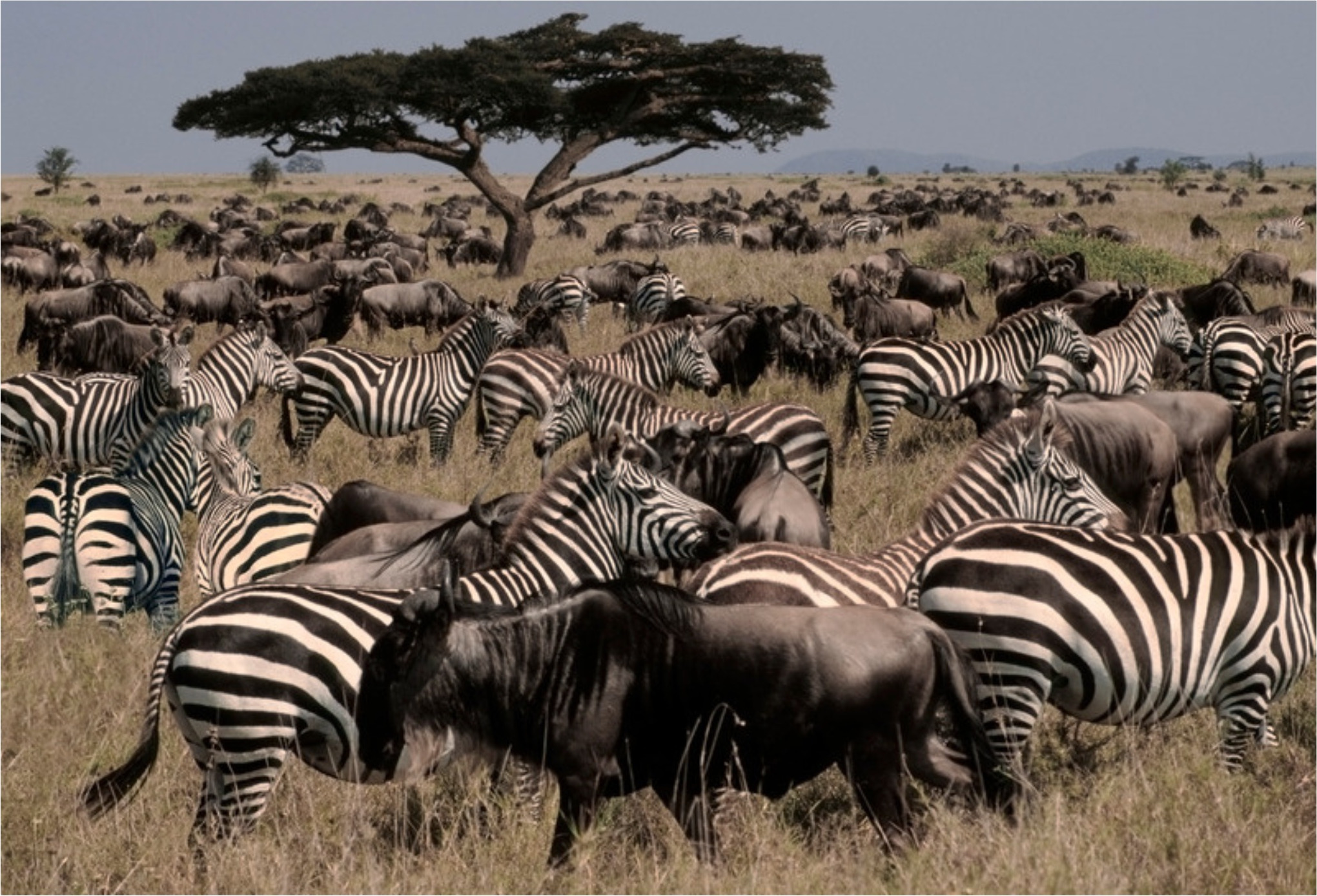
The migration is not an event with a date. It is roughly two million wildebeest, zebra, and gazelle moving in a continuous loop, following rain and grass. They are always somewhere. The planning question is only where.
A rough calendar: the herds calve on the southern plains from December through March, move west and north through April and May, reach the Grumeti in May and June, hit the Mara River crossings in the north from late July through October, and turn south again in November.
Two honest cautions. First, these are patterns, not a timetable — an early or late rainy season shifts everything by weeks. Second, a river crossing is the least predictable sighting in African safari. Herds can mass at the bank for a day and never go. Anyone who guarantees you a crossing on a specific date is selling something they do not control.
We have deeper pieces on the best time to visit Serengeti National Park and on the best month for the wildebeest migration if you want the detail.
If you want the highest chance of dramatic river crossings, aim for August and September in the north. If you want newborn animals and heavy predator action with fewer vehicles, aim for February in the south. If you simply want excellent general game viewing at a lower price, the long rains of April and May empty the park and drop lodge rates substantially.
June through October is the dry season and the busiest, most expensive window. It is also the easiest, with cool mornings, thin vegetation, and animals concentrated around water.
A common mistake is planning entirely around the herds and treating everything else as a bonus. The Serengeti has one of the densest lion populations on earth, plus leopard, cheetah, spotted hyena, elephant, buffalo, giraffe, and well over 500 bird species.
Rhino are the hard one. There is a small, protected population, but if seeing rhino matters to you, we would build in Ngorongoro Crater or a Kenya leg rather than let you hope. Being straight about that upfront is part of the job.
Most people find the thing they remember is not the rarest animal. It is a scale problem — standing in a vehicle with grass running to the horizon in every direction and no structure in sight.
This worries American travelers more than almost anything else, and the worry is based on the wrong picture.
A Serengeti tented camp is not camping. A typical one has a proper bed with linens, an en-suite bathroom with a flushing toilet and a hot shower, rugs, furniture, and a dining tent with full meals. The canvas walls are the only thing making it a tent. What you give up is soundproofing — you will hear hyena at night, and most people end up describing that as the best part.
Your options run from permanent lodges with pools and solid walls, through semi-permanent luxury camps, to mobile camps that relocate seasonally to follow the herds. Mobile camps are the ones that put you closest to the migration, since they move with it.
Power is usually solar with set hours. Wi-Fi exists in most camps now and is slow. We tell people to plan on being unreachable for stretches and to set that expectation with family before they leave.
Much less than most people assume. A Serengeti safari is conducted almost entirely from a seated position in a vehicle. There is no hiking requirement, no altitude problem — the plains sit around 5,000 feet, comparable to Denver — and no minimum fitness level.
What is genuinely tiring is different: early starts, several hours a day on corrugated roads, and dust. If you have back or hip issues, tell us, because it changes which vehicle and which routing we recommend, and it is a reason to fly between regions instead of drive.
We regularly send travelers in their sixties and seventies to the Serengeti. Mobility limitations are usually a design problem, not a disqualifier. Medical facilities are limited inside the park, so evacuation insurance is not optional on a trip like this — the CDC’s Tanzania travel health page is a good starting point for vaccinations and health prep.
Most of a Serengeti price is not profit — it is fixed cost. Tanzania charges a per-person, per-day park entry fee for non-residents, plus separate concession fees for camps built inside the park, plus VAT. Those are set by the government and change periodically, so we quote them live rather than publish a number that goes stale. No operator can discount them.
On top of that sit your accommodation, your vehicle and guide, fuel, and any light-aircraft legs. Fly-in routing is usually the single largest optional line item.
For a sense of scale, a well-run private Tanzania safari of a week or so generally lands in the range of a nice European vacation for two, or somewhat less than a new car — for something most people describe afterward as the trip of their life. When you compare quotes, look at what is inside the number. A cheaper quote frequently means a camp outside the park boundary, which quietly costs you an hour of driving in each direction every single day.
You will see Serengeti packages advertised at a fraction of a private trip. It is worth understanding exactly what changes.
On a group departure you share a vehicle with strangers, on a fixed schedule, with a guide splitting attention across everyone. If you want to stay 40 minutes with a leopard and someone else wants lunch, lunch wins. Photographers get the wrong seat. Someone always wants to leave when you want to stay.
On a private trip the vehicle is yours. You decide when the day starts, how long you sit with a sighting, and whether today is a slow day. Your journey is private; the wildlife encounter is shared. If a $3,000 group tour is genuinely what fits your budget, that is a real and reasonable choice — we would just rather you know what the difference actually buys.
All in Africa Safaris USA is registered in Utah. You sign a US contract, pay a US company, and call a US phone number in your own time zone when you have a question. There is no request to wire money to an individual overseas and no booking conducted entirely over a messaging app.
The trip itself is run by All in Africa Safaris (U) Ltd, our licensed partner operation in Kampala, working in Tanzania since 2017. They handle guides, permits, vehicles, and camp reservations on the ground. You get the accountability of a US business and the pricing of a local operator, rather than paying a US middleman to email an African operator on your behalf.
If you are weighing operators, the checks worth running on any of them are the same: a real business registration you can verify, a written contract, a phone number a human answers, and a payment process that does not involve sending money to a person.
Three nights inside the park is the practical minimum, and four or five is materially better. Anything shorter and travel time eats most of it. Many travelers pair the Serengeti with Ngorongoro Crater and Tarangire on a week-long northern circuit, which is how our 7-day private northern Tanzania safari is built.
Yes, with normal precautions. Northern Tanzania’s safari circuit is heavily dependent on tourism and is managed accordingly. You are with a professional guide throughout, and camps have staff on duty overnight. The genuine risks on this trip are road travel, sun, and stomach upset — not wildlife or crime. Check current US State Department advisories before you travel.
No, and be cautious of anyone who says otherwise. You can maximize your odds by being in the north between late July and October and staying several nights, but the herds move on their own schedule. Treat a crossing as a spectacular possibility rather than the point of the trip.
No particular fitness is required — game viewing is done seated in a vehicle at moderate elevation. Tell us about mobility, back problems, or medical conditions during planning, since those affect vehicle choice and whether we route you by air between regions.
Look for a verifiable business registration, a written contract that names what is included, a working phone number, and payment to a company rather than a person. Be wary of pressure to pay by wire transfer or cryptocurrency, of bookings conducted only through social media, and of prices dramatically below everyone else’s — park fees are fixed, so unusually cheap quotes are cutting something you will notice.
Ready to start planning your private African safari? Contact All in Africa Safaris USA today for your personalized itinerary. Tell us roughly when you want to travel and what you most want to see, and we will tell you honestly whether the Serengeti is the right park for it.
