
Utah Office | USA/Canada
Call or Text | +1 (801) 899-6806
Email Support safari@allinafricasafarisusa.com
Office Hours: M-F 9:00 am - 5:00 pm MST
Off: US Holidays
Off: US Holidays
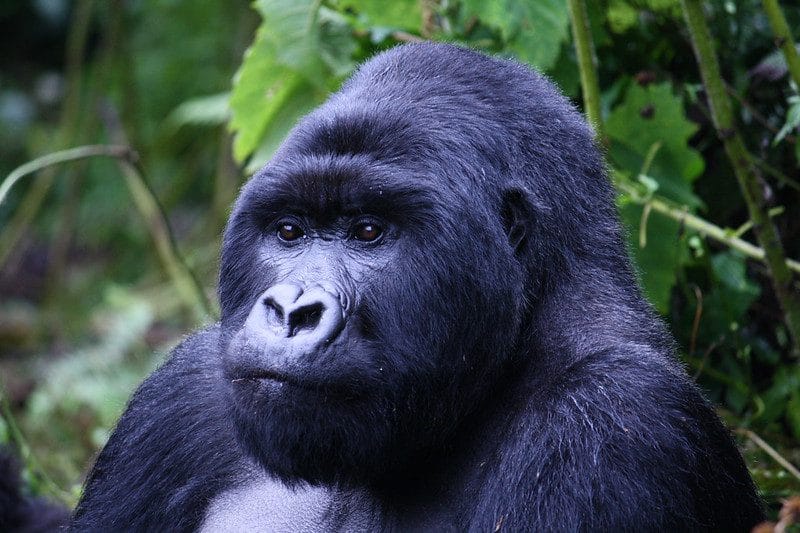
Gorilla trekking typically lasts between two and six hours from the moment you leave the briefing point to the moment you return, though it can run as short as one hour or as long as eight. Exactly one of those hours is spent with the gorillas. The rest is the walk.
I am Barton Jeffs, and I run All in Africa Safaris USA from Utah. This is one of the most practical questions a traveler can ask, because the answer determines what else fits into that day and how fit you need to be.
Most travelers ask this expecting a single number. There isn’t one, because you are looking for wild animals that moved overnight.
Here is the honest range:
Plan your day as though it will take a full day. If you finish by lunchtime, treat it as a bonus rather than the expectation.
The structure is the same in Uganda and Rwanda.
6:00 to 7:00 a.m. — Arrival and briefing. You reach the park headquarters, present your passport and permit, and receive a briefing on the rules. Trekkers are sorted into groups of eight, each assigned to one gorilla family.
8:00 a.m. — The walk begins. Trackers went out at dawn to locate where each family nested. Your ranger stays in radio contact with them, so you are walking toward a known position rather than searching blindly.
Somewhere between 1 and 6 hours later — You find them. The ranger will tell you to leave your bags and poles behind and approach quietly.
One hour — Time with the gorillas. Strictly enforced, timed from the moment the group is sighted.
The return walk. Usually faster than the approach, since you are retracing a known route and often heading downhill.
The hour is not arbitrary, and rangers do not extend it.
Disease. Mountain gorillas share close to 98 percent of our DNA and can catch human respiratory infections. Less exposure means less risk. This is also why you keep roughly seven meters back and why anyone visibly ill is turned away.
Stress. These are habituated families, not tame ones. Habituation means they tolerate human presence, and conservation authorities limit that presence to keep it tolerable.
Keeping them wild. Gorillas that become too comfortable with people are more likely to leave protected forest and enter farmland, where the outcome is rarely good for them.
An hour sounds short. Nearly every traveler I have sent finds it is longer than they expected in the moment, and more than enough.
Where the family nested. The single largest factor, and entirely out of anyone’s control. Gorillas build fresh nests each night and can move a considerable distance in a day.
Which family you are assigned. Some are habitually closer to the trailhead than others. At the briefing, rangers ask about fitness and mobility precisely so they can match travelers to families sensibly. Answer honestly rather than optimistically.
Terrain and weather. Bwindi earned the name Impenetrable. After rain, the slopes are slick and progress slows considerably.
Your group’s pace. A group of eight moves at the speed of its slowest member.
Not dramatically, but the character of the walk does.
Bwindi Impenetrable National Park, Uganda. Dense forest, steep ravines, thick undergrowth. Lower altitude than Rwanda, so breathing is easier, but the vegetation is harder work. Permits are $800.
Volcanoes National Park, Rwanda. More open terrain on volcanic slopes, but at higher altitude, which travelers coming from sea level often feel. The park is closer to Kigali, so the drive is shorter. Permits are $1,500.
Rwanda’s shorter transfer time is the real difference in how the day feels. We cover the full comparison in our guide to gorilla trekking in Uganda vs Rwanda.
Moderate. It is not a technical climb, and no special skills are required. What it demands is the ability to walk uphill on uneven ground for several hours.
A reasonable benchmark: if you can manage a three-hour hike with meaningful elevation gain at home, you will be fine. If that sounds difficult, tell us during planning so we can weight your itinerary toward Rwanda’s more open terrain or request a closer family.
Rangers set the pace deliberately and will not leave anyone behind. Nobody is racing.
Because every trip we plan is private, we can build the surrounding days around how strenuous you want this one to be. Your journey is private; the wildlife encounter is shared.
Do not schedule anything demanding after a gorilla trek. No long drives, no second activity, no flights.
The reason is simple: you cannot know in the morning whether you will be back at 11 a.m. or 5 p.m. Build the day loosely and let the trek take the time it takes. That flexibility is one of the genuine advantages of a private itinerary over a fixed group departure, where the coach leaves when the coach leaves.
Park regulations and current permit information are published directly by the Uganda Wildlife Authority.
All in Africa Safaris USA is registered in Utah. Your payment and contract are with a US company under US law, with no overseas wire transfer required.
Our partner, All in Africa Safaris (U) Ltd in Kampala, has handled guides, permits, and park logistics since 2017. They secure the permits and brief the rangers on your group’s fitness before you arrive.
You can browse our Uganda safari itineraries or Rwanda safari itineraries as starting points.
Two to six hours is typical, including one hour with the gorillas. Short treks can finish in an hour; difficult ones can run eight hours or more. Plan for a full day.
To limit disease transmission, reduce stress on the family, and keep the gorillas from becoming too accustomed to people. The hour is timed from first sighting and is not extended.
Bwindi in Uganda has denser vegetation and steeper ravines. Volcanoes in Rwanda is more open but higher, so altitude is a factor. Neither is consistently harder.
Rangers set the pace to the group and will not leave anyone. Porters assist on steep sections, and sedan chairs can be arranged in advance for travelers with limited mobility.
Yes, and many travelers do. A second permit on a different day often means a different family and a completely different experience. We can build that into your itinerary.
Yes. You pay All in Africa Safaris USA, registered in Utah, under a US contract. No international wire transfer is needed.
Ready to start planning your private African safari? Contact All in Africa Safaris USA today for your personalized itinerary.